Saturday, February 23, 2013

Island bright sparks beat electricity price boost

It was predicted and it has happen: the cost of electricity is going through the roof. The price freeze bought in by the Queensland LNP government has been crushed by a massive increase this year.
The draft determination of the Queensland Competition Authority relased this week forecasts

  •  21.4% price increase for the common household tariff (Tariff 11) and 
  • 15.7% for small business customers (Tariff 20) across Queensland.
From the reaction of the Queensland Government lead on this matter, Tim Nicolls, you would have though that this was something new and unpredictiable.  The fact is that we have known that the prices would rise for many years. The Australian The Australian Energy Market Commission predicted all of this in its 2010 paper on future price rises so everyone, the Governments, the wholesalers, the retailers and the consumers knew it would happen. The LNP had no hope of shifting the deck chairs around in order to prevent the rise, its freeze promised in the election last year has melted in the face of reality. This reversed the policies of the previous government which was one of alerting us to the trend and gently pushing us, with free usage checks and encouraging solar installation, towards a sustainable use of power.

Here is the Commission's predicted breakup in order of magnitude:
  • Distribution services - 41% contribution
  • Wholesale electricity -19% contribution
  • Retail electricity -14% contribution
  • Renewable Energy Target (LRET/SRES) - 11% contribution
  • Transmission services - 8% contribution
  • Feed-in tariffs - 3% contribution
  • Other jurisdictional schemes - 3% contribution
So its the grid and the cost of conventional (read coal-fired powerplants) that are 60% of the increase. The grid is old and needs replacement.  Carbon tax and feed-in tariffs are a small percentage in comparison. 
Although demonized by the entrenched suppliers, renewable energy which includes rooftop solar contributes only 4.5% to additional electricity costs. 
Here on the islands, many did take notice and grabbed the generous subsidies being offered by both the State and Commonwealth to install solar panels on their roofs while they were on offer.  That is why, today, we have the highest density of solar panels in the State and will be somewhat cushioned from the increase later this year.
And the good news is that the cost of putting more solar on your roof is continuing to come down.  The Macquarie Group, one of the most hard headed investors in Australia has pointed out that, based on world trends, rooftop solar is now "unstoppable"  Looking at the German market, the Macquarie experts say:
"ever-increasing prices for domestic and commercial customers as well as rapid solar cost declines have brought on the advent of grid parity for German roofs. Thus, solar installations could continue at a torrid pace”
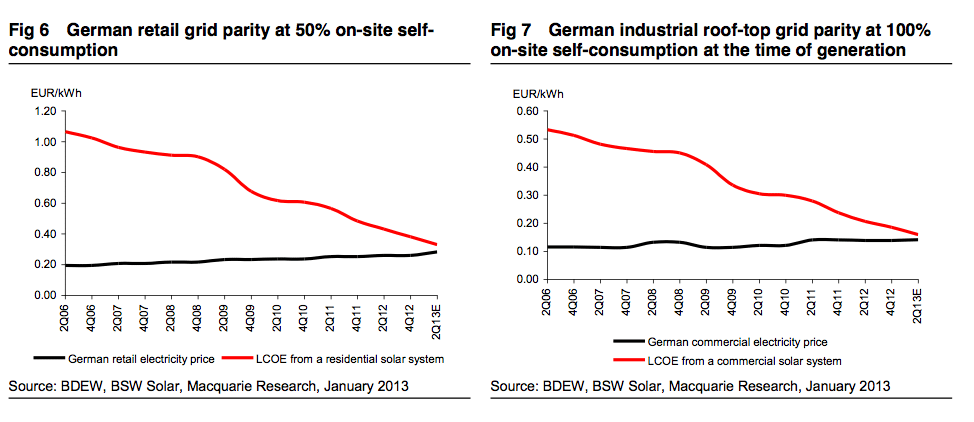
For once, the islands, thanks to the efforts of people like +Rod Young in organising the big group buys of solar panels a few years back, is well ahead of the curve and laughing all the way to the bank with their canny investment in panels ticking up the kilowatts on our roofs.  What is more we have a bunch of tradies skilled up in the installation and servicing of panels.
Now, if we could only figure a way of getting to all that power when the grid goes off the air like it did a month ago.

Monday, February 11, 2013

Stradbroke poll results faked?

Accurate reporting in the 1980s by the Courier Mail, gave
an accurate portrayal of where the bridge was supposed
to go.  This was later abandoned when the two private
firms who proposed the bridging found that the offering of
land on Stradbroke would not be profitable.
Just after Christmas is known as the silly season in Australian journalism.  A time when the cream of the journalists take leave because there is little real news.  Everyone is on holidays and the second stringers are left to make something out of what scraps of news are available.
At that time beat ups are common and all kinds of diversions--such as hitting the streets to interview anyone and everyone on burning questions are the stuff of the news.  Of late, dubious online polls have become part of the mix.
So it was no surprise that when Queensland Education Minister, John-Paul Langbroek suggested in an unguarded moment,  a bridge to Stradbroke might have to be reconsidered in the future, the Courier Mail went to town.
Strong denials came from local member Peter Dowling, the responsible Queensland Transport Minister, Scott Emerson, and the Mayor of Redlands, Karen Williams that such a course was not on the cards but the bridge fanatics ran away with it.
January poll by Courier Mail
The Courier Mail's online poll initially found a balance of for and against but suddenly, a few days after the start of the poll, the number of people wanting the bridge exceeded 17000 while the no vote remain virtually unchanged.
I was attacked at the time on the BayJournal for daring to suggest that the results may have been corrupt.  One said:
your post smacks of bias and paranoia. When are you going to admit the majority obviously supports a bridge and the ongoing infrastructure it will facilitate. You have used polls before to justify your argument, but only if they promote your opinion. I say you are only seeing what you want to see.
Well now we have proof that polls run by News Limited have been adulterated.
Tonight on MediaWatch, the ABC's well respected media watchdog, showed that News Limited has not only been hacked and many polls have been falsified but that it has not done anything about them when the issue was pointed out.  See the full segment with supporting evidence here
Just because polls are published by a major media organisation, doesn't make them true.


Monday, February 4, 2013

Storms: a "Titanic" moment?

A false sense of security
The usual monthly Russell Island Association meeting on Saturday was not a happy one.
We were all smarting from the storms and particularly from the loss of power for four days but most of all from not knowing what was going on.
It was not supposed to be like this: the power outages of the past were supposed to have been fixed by the building of a substation on the island. 
Many people on Russell had a Titanic experience.
It wasn't just the smelly mounds of frozen meat and other food being taken to the dump or the trees being ripped up: it was not knowing what was going on.
Unlike the mainland where the radio stations were keeping householders reasonably informed about local problems, we had nothing or worse, misinformation about when and what services would come on line:
  • Russell Island's only retail food store, closed suddenly when the blackout came in an effort to save the cold stock.  No generator backup and no explanations.
  • Without power and no hand pumps, the only service station was closed too. Thus there was a wild rush to the mainland to pick up more fuel for generators.
  • We soon ran through what ice was available from the local liquor store
  • The Bowls Club remained open because it had by some miracle power on.  Those who knew were able to find refuge there and contributed to a giant cook out to keep people fed.  But many were in the dark and assumed that it, like most of the rest of the islands was shut down.  
  • RSL Club, that was shut tight and was not online until a day after power was restored. Up until the power cut, it had been a rallying point with the big screen television giving news of what was happening in the wider world.
  • It was next to impossible to find out when and where ferries might arrive so people could not plan shopping trips to the mainland--even if they could get there through the downed trees and powerlines.
On Macleay, it was nowhere near as bad because at least one of the foodstores had a generator and the Council was able to keep it running with a delivery of fuel. 
But the biggest problem was just not knowing. No disaster recovery centre had been set up for the island. No emergency routines had been put in place despite appeals for many years for some clear plans to be put in place. 
It would be easy to blame the victims here: every household should have had enough to see them through but we are not talking about a normal population here.  The population has doubled on Russell in the last ten years and seen an influx of urban dwellers rather than people used to the rigours of isolation that the older residents were prepared for. If you hadn't noticed it is almost impossible now to buy a phone that will work without being plugged in.  Smartphones died as batteries petered out. Even if you did get through to the electricity people you were given wildly optimistic times for power restorations.
And there are aspects that are only just coming to light: many of the newly installed and mandatory household sewerage plants require power to operate--how much damage has been done to them and consequently to the environment is not known. 
This was systemic failure.  We didn't hit an iceberg but we were victims of the same kind of thinking both from authorise and at a personal level.  When the Titanic went down, enquiries found the deficiencies and safety at sea was vastly improved.  Will we learn the same kind of lesson from this minor disaster or will it all be forgotten until the next time?
The only retail establishment open on Russell after the storm was the local bottleshop.